
What does the next artist need to understand without opening a node group’s internals? A reusable group needs a clear task, understandable controls and visible assumptions.
Blender’s 5 October 2026 Geometry Nodes workshop account discusses exposing bake controls through group interfaces and making node-group compatibility more understandable. Those sections include proposed designs and mock-ups. This article uses the interface problem as context, without claiming that the proposed controls are present in a particular released build.
Give each input a job
For a hypothetical reusable group, describe the intended task in one sentence. Then identify the controls a receiving artist actually needs, their meanings and any units or expected ranges that the group’s own design establishes.
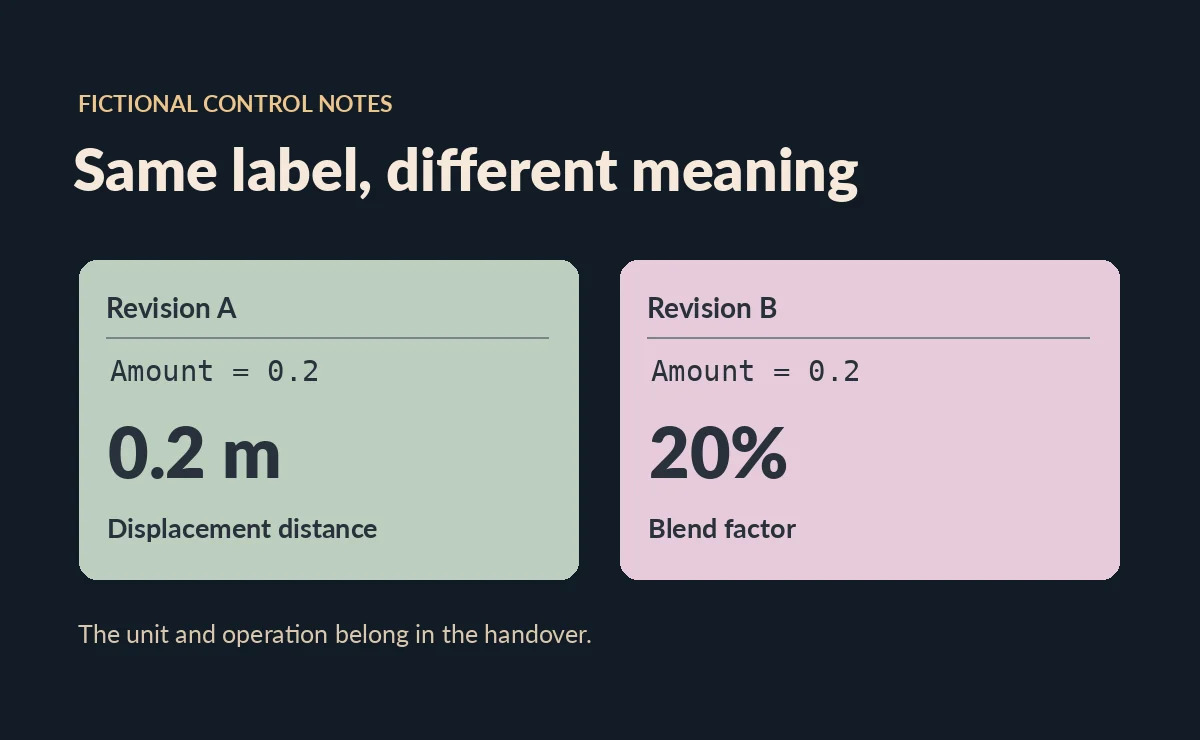
Here is a filled, fictional control note: “Revision A: Amount = displacement distance in metres; saved value 0.2 means 0.2 m. Revision B: Amount = unitless blend factor; saved value 0.2 means 20% of the defined blend.” The identical label and number now describe different operations. These are invented group designs, not built-in Blender controls.
The handover should say which revision replaces which, explain the new operation and retire instructions that still describe metres. Copying the old value into the new group preserves the digits, not the result. A reference input and expected output would make the change easier to examine.
Separate required preparation from ordinary use
If the group’s workflow needs preparation, a bake or another deliberate operation, explain what has actually been implemented in the handed-over version. Do not invent a button because a workshop mock-up shows where one might go.
Record the relevant Blender build, group revision and input dependencies. If the group is intended for one node context, do not infer compatibility with another simply because some internal nodes are shared.
- What task is the group meant to perform?
- Which input changes what, under which stated assumptions?
- What preparation and dependencies does this version require?
- Which context and build have actually been considered?
Keep an example separate from a promise
A small reference scene can communicate the intended use. Retain its revision and explain what it demonstrates, including any limits. It is not evidence that every input combination or receiving scene will behave as expected.
If a change alters a control’s meaning, update the accompanying explanation and identify the new group revision. A familiar socket name should not conceal a different behaviour. Tell the recipient which earlier interface or reference the revision replaces, rather than leaving two different meanings under one unchanged label.
The useful handover is an interface the next person can question and understand. It links controls to a specific task while leaving proposed developer features and untested compatibility clearly outside the demonstrated version.