
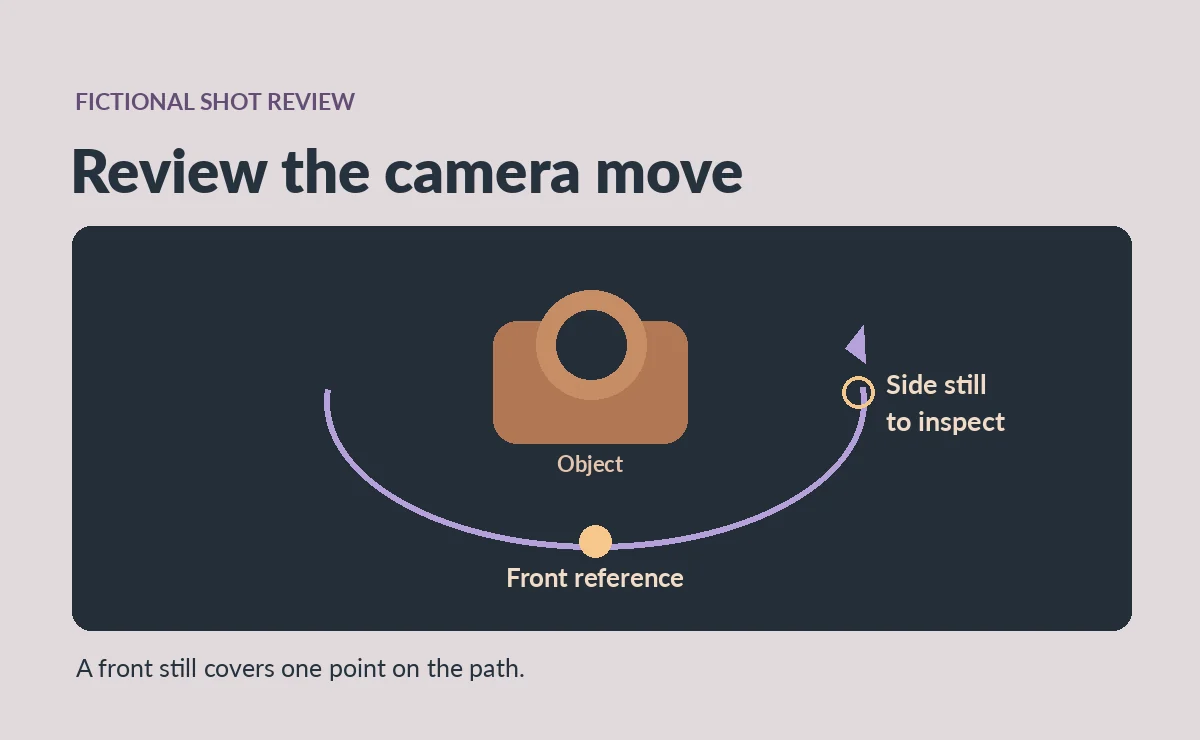
A captured object looks convincing from the front. The planned shot moves around its side. Before approving the capture, the production needs evidence from that move—not another attractive front still.
Blender’s 30 October 2026 Gaussian-splatting account describes initial support in Blender 5.3. It explains a representation made from Gaussian elements rather than a conventional surface mesh, and documents different rendering approaches in EEVEE and Cycles.
What the capture contains
The developer account describes elements with position, scale, rotation and radiance. Radiance includes view-dependent appearance. This helps explain why a convincing captured look is not the same deliverable as an editable mesh with separately authored materials.
For a shot intended to reproduce a captured appearance, that representation may be useful. A request to remodel a surface or establish a different lighting setup asks for something else. The file’s ability to open cannot settle all three tasks.
A new view is a new review question
In our fictional shot, the front still establishes only what that reference shows. It cannot reveal whether the side of the object will remain convincing throughout the camera move. The next review should cover the intended camera path and frame range in the receiving build.
This does not mean the side must fail. It means that its quality is uninspected. Keeping “unknown” distinct from “bad” prevents a missing review from becoming either a false approval or an unsupported rejection.
Why switching engines can change the result
The documented EEVEE approach projects splats towards the camera; Cycles finds ray intersections, including for rays beyond the primary camera view. The developers show that these approaches can differ. A reference rendered in one engine should therefore remain labelled with that engine.
For a comparison, hold the camera, capture revision and output conditions steady where possible. If the lighting, samples and camera all change, the resulting difference cannot simply be assigned to the renderer.
Relighting is a separate demand
The source describes relighting as early work and notes that the representation carries view-dependent radiance. An example of changing its lighting does not establish every material or compositing requirement of a production.
A useful acceptance note names the capture and permitted use, the inspected move, the engine and any unresolved frame. No capture was tested for this article. The decision method is nevertheless concrete: approve the conditions actually reviewed and keep a changed camera or look visible as new work.